Technologies Cases - Real solutions. Proven results.

Tier-1 Fuel Component Manufacturer + Cobot-Integrated AI Vision System Inspection
The Challenge
A major manufacturing client faced a critical quality control challenge when their end-client discovered scratches on the cone surface of delivered parts. These defects were escaping manual inspection processes, leading to rejected shipments and straining the relationship with a key account. The scratches were often subtle, irregular, and located on a curved geometry, making them notoriously difficult for human operators to consistently identify during high-volume production runs. The client needed an immediate, foolproof solution to stop the "quality spill" and restore confidence, as continuing to ship defective parts posed a significant risk to their contract and brand reputation.
Our Solution
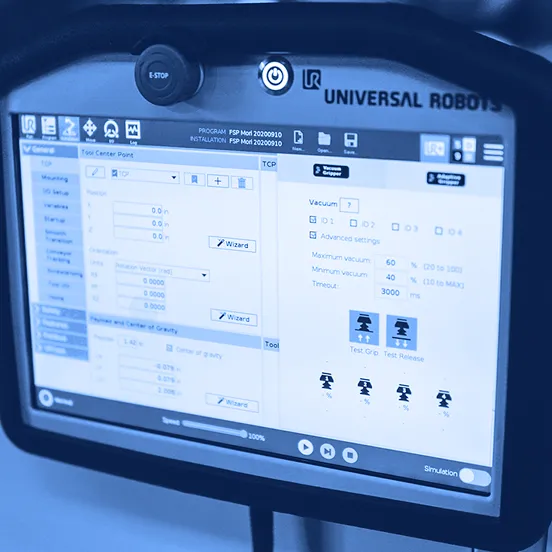
To address this, our team engineered a custom, automated inspection station designed to eliminate human error and variability. We approached the problem by combining the flexibility of a collaborative robot (Cobot) with the advanced detection capabilities of an AI-driven vision system. Unlike traditional rule-based vision systems that struggle with varying surface textures and lighting on curved parts, the AI model was trained on image samples to distinguish between acceptable surface variations and actual scratch defects on the cone. The collaborative robot was integrated to handle the parts delicately and precisely, presenting them to the camera at consistent angles to ensure 100% surface coverage, all while maintaining a safe, fence-free footprint for operators.
The Results
The implemented solution was a complete turnkey station—developed, designed, manufactured, and installed by our team—that validated every single part for cone scratches prior to shipment. The system's impact was immediate: it completely halted the outflow of defective parts, effectively solving the quality crisis and securing the client's relationship with their customer. Beyond immediate quality improvements, the station has proven to be exceptionally robust. It has now been in continuous operation for over three years with no significant downtime, demonstrating not just technical precision but also the industrial-grade reliability required for long-term manufacturing success.
OEM Automotive Component Manufacturer + Light Guide System
The Challenge
The client was managing a complex assembly environment with multiple production lines dedicated to building different variations of a single component type. Because the complexity varied significantly between models, the existing setup required a sprawling manufacturing footprint and a team of six operators to maintain throughput. This heavy reliance on manual labor created two critical issues: high operational costs and inconsistent build quality. With six different individuals interpreting assembly methods slightly differently, "build variation" became a persistent problem, leading to unpredictable product performance and an inability to guarantee a standardized output across all part variations. The client needed a way to consolidate these builds, recover valuable floor space, and drastically reduce the headcount from six to three or fewer.
Our Solution
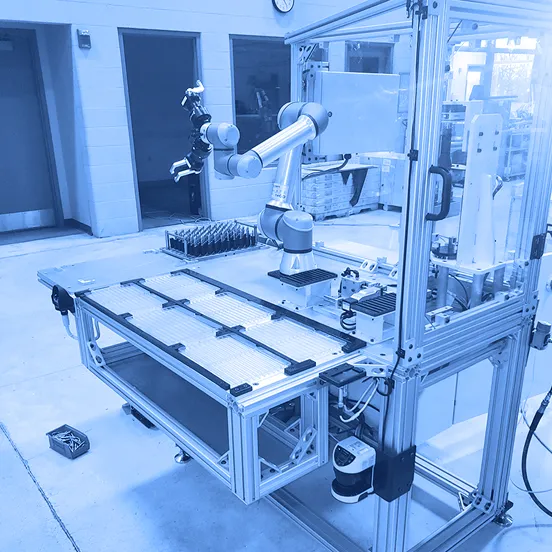
To solve this, we moved away from the traditional multi-line setup and developed a centralized, custom Augmented Reality (AR) workstation. Our team handled the complete lifecycle of the project—designing, manufacturing, building, and installing the system—to ensure seamless integration. The core of our approach was to replace static work instructions with dynamic AR overlays that guide the operator step-by-step through the assembly process directly on the physical part. This digital guidance system allowed us to "de-skill" the complexity of the varying part builds, ensuring that a single station could handle every variation with the same level of precision. By locking the process into the AR software, we eliminated the possibility of human interpretation errors, ensuring that the build process was rigid, repeatable, and standardized.
The Results
The implemented solution exceeded the client’s initial targets by consolidating the workload of six operators into a single, highly efficient station—reducing headcount from six to one. This massive efficiency gain was accompanied by the total elimination of build variation, as the AR system ensured every part was assembled exactly to spec, regardless of complexity. The durability of the system has been proven in the field, having run non-stop for five years with zero significant downtime. The success of this project not only solved the immediate production bottleneck but also established a trusted partnership; the client was so impressed by the ROI and reliability that they have since commissioned a second custom AR solution to further modernize their operations.
Automotive and Industrial Component Manufacturer + Cobot-Driven Automated Bearing Staking
The Challenge
The client utilized a staking process to secure ball bearings into nozzle assemblies, a critical operation where the bearing is intentionally smashed and flattened into the hole to create a permanent seal. However, the execution of this process was entirely manual and highly inefficient. With five different nozzle variations requiring anywhere from two to six bearings each, the operator was forced to perform a tedious, multi-step sequence for every single hole: loading the nozzle, placing the bearing, aligning the press, inserting a pin, and triggering the smash before manually indexing to the next position. This repetitive workflow created a severe production bottleneck, as the sheer volume of manual manipulations required for a single finished part made it impossible to scale production or utilize the operator for higher-value tasks.
Our Solution
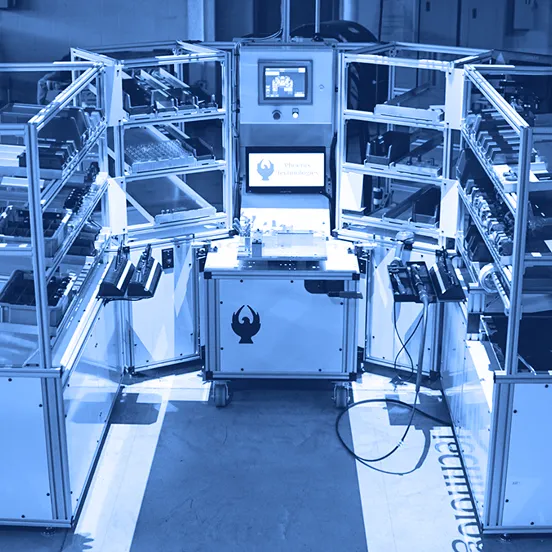
To address this labor inefficiency, we designed a fully automated cell centered around a PLC, a collaborative robot (Cobot), and an integrated vision system. We moved the process away from single-piece handling to a high-capacity batch workflow, engineering a custom fixture tray capable of holding 48 nozzles at once. In this new design, the Cobot picks each nozzle and presents it to the vision system for precise inspection and verification. Once approved, the Cobot places the nozzle into a specialized custom fixture designed to automatically index the part. This fixture rotates the nozzle precisely after each press cycle, presenting the next hole to the staking tool, which allows the system to rapidly "smash" each bearing into place without manual intervention.
The Results
The resulting machine—designed, manufactured, built, and installed by our team—has completely transformed the operation into a streamlined "load and leave" process. The operator’s role is now limited to loading a tray of 48 nozzles, checking the hopper, and selecting the specific nozzle profile on the system’s HMI. This single selection instantly reconfigures the entire cell: the Cobot adapts its motion paths and the vision system loads the corresponding inspection job for that specific part variation. This solution eliminated the manual bottleneck, allowing the operator to manage other equipment while the tray runs. Since installation, the machine has demonstrated exceptional durability in a production environment, recording over 23 months of continuous uptime without any significant downtime.